29 July 2026
Finite Element Analysis Training with ANSYS for the Defense Industry and Advanced Eng. Applications
Dear IGU Members,
The success of product development processes in the defense industry, aviation, and advanced engineering applications depends on accurate simulation, reliable analysis, and effective validation. In this regard, Computer-Aided Engineering (CAE) and the Finite Element Method (FEM) are among the fundamental components of design validation and engineering decision-making.
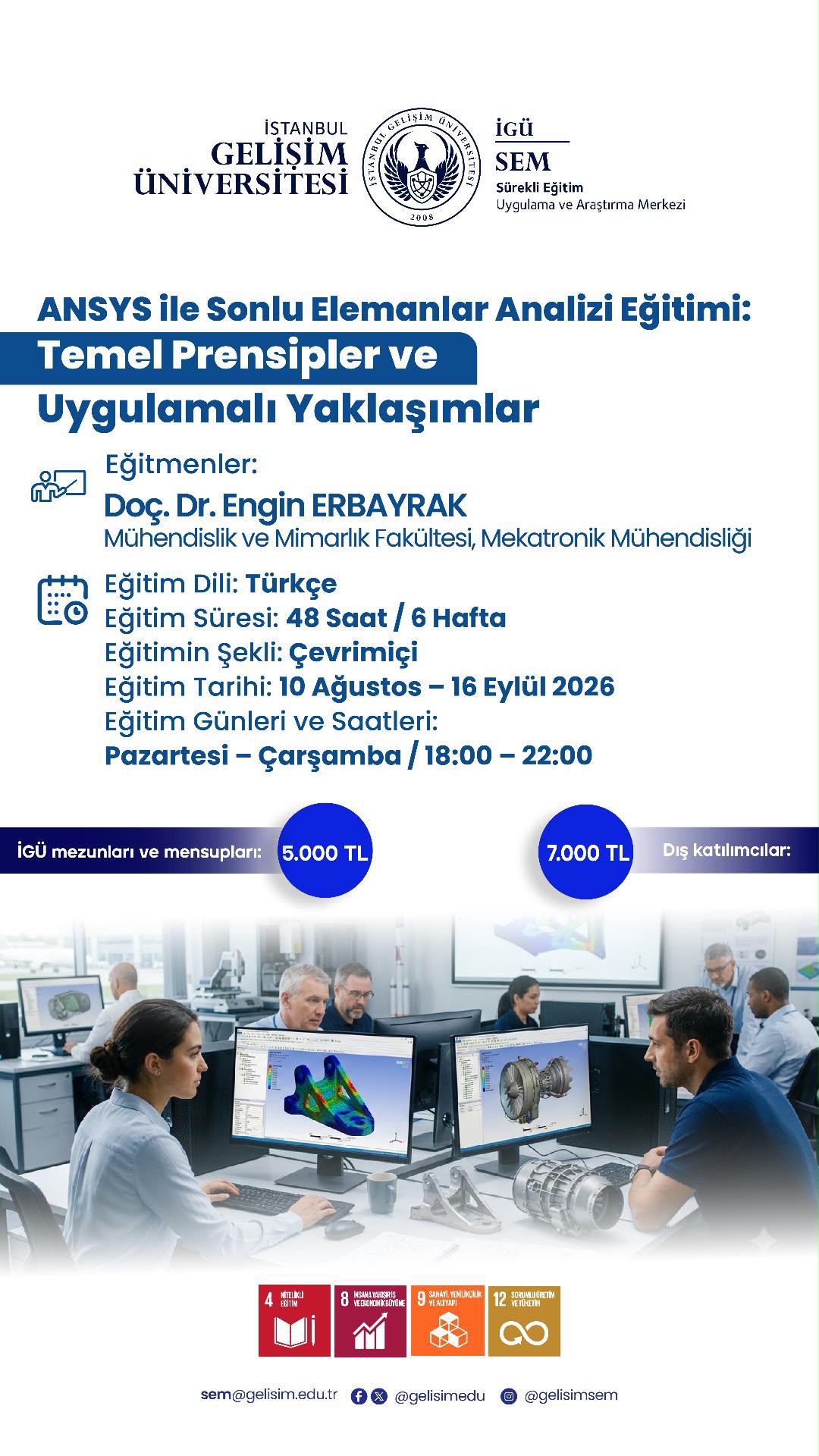
The “Finite Element Analysis Training with ANSYS: Fundamental Principles and Applied Approaches” program, organized by the Istanbul Gelişim University Continuing Education Application and Research Center (İGÜSEM), aims to help engineers, researchers, and technical experts enhance their analysis skills within the ANSYS Workbench environment.
The program will be led by Assoc. Prof. Engin ERBAYRAK, an assistant professor in the Department of Mechatronics Engineering at Istanbul Gelişim University, and features a comprehensive curriculum in which theoretical knowledge is reinforced by real-world engineering applications.
Program Information
The success of product development processes in the defense industry, aviation, and advanced engineering applications depends on accurate simulation, reliable analysis, and effective validation. In this regard, Computer-Aided Engineering (CAE) and the Finite Element Method (FEM) are among the fundamental components of design validation and engineering decision-making.
The “Finite Element Analysis Training with ANSYS: Fundamental Principles and Applied Approaches” program, organized by the Istanbul Gelişim University Continuing Education Application and Research Center (İGÜSEM), aims to help engineers, researchers, and technical experts enhance their analysis skills within the ANSYS Workbench environment.
The program will be led by Assoc. Prof. Engin ERBAYRAK, an assistant professor in the Department of Mechatronics Engineering at Istanbul Gelişim University, and features a comprehensive curriculum in which theoretical knowledge is reinforced by real-world engineering applications.
Program Information
- Program Dates: August 10–September 16, 2026
- Duration: 6 weeks (48 hours)
- Class Days: Mondays and Wednesdays
- Time: 18:00–22:00
- Format: Online (Live classes and access to class recordings)
- Capacity: Limited to 15 participants.
- Tuition: IGU Alumni and Affiliates: 5,000 TL / External Participants: 7,000 TL
Training Objective
Success in product development processes within the defense industry, aerospace, and advanced engineering applications depends on accurate simulation, reliable analysis, and effective validation. In this context, Computer-Aided Engineering (CAE) and the Finite Element Method (FEM) constitute fundamental components of design verification and engineering decision-making.
This training program aims to equip engineering students, researchers, academics, and engineering professionals with a solid understanding of the fundamental principles of the Finite Element Method (FEM) while providing hands-on experience in the numerical analysis of engineering problems using ANSYS Workbench.
By integrating theoretical knowledge with real-world engineering scenarios, participants will gain a comprehensive understanding of structural analysis processes and develop the ability to solve engineering problems through simulation-based approaches.
Who Can Attend?
Engineering Students (Bachelor’s / Master’s / PhD)
- Especially students in mechanical, mechatronics, civil, aerospace, materials, and industrial engineering.
- Those conducting analyses for graduation projects or theses.
Academics and Researchers
- Individuals performing scientific studies using the finite element method.
- Those who use or wish to use ANSYS in publications and projects.
Engineers and Technical Professionals
- Engineers working in R&D, design, and analysis units.
- Professionals using simulations in product development processes.
Recent Graduates
- Candidates seeking to enhance technical competence for job applications.
- Individuals aiming to specialize in CAE (Computer-Aided Engineering).
Technical Staff and Designers
- Technical personnel involved in CAD/CAE processes.
- Practitioners wishing to interpret analysis results.
Main Topics to Be Included in the Training
- Basic principles of Finite Element Analysis (FEM)
- Mesh generation and quality criteria
- Modeling of isotropic and composite materials
- Static structural analysis
- Modal analysis
- Thermal analysis
- Fatigue analysis
- Stress, strain, and safety factor evaluations
- Sample analysis studies for engineering applications
Training Topics and Content
-
Introduction and Basic Concepts
- Principles of the Finite Element Method (FEM)
- Introduction to the ANSYS interface
- Types of engineering analyses (static, dynamic, thermal, etc.)
- Geometry and Modeling
- Creating and importing geometry (CAD integration)
- Model simplification techniques
- Types of meshes and quality criteria
- Mesh sensitivity analysis
- Isotropic and anisotropic material properties
- Composite material modeling
- Definitions of forces, pressures, moments, and temperature
- Contact definitions
- Static structural analysis
- Modal analysis
- Thermal analysis
- Fatigue and strength analyses
- Interpretation of stress, deformation, and safety factors
- Visualization of results
- Meshing
- Material Definition
- Boundary Conditions and Loading
- Types of Analysis
- Solution and Results Evaluation
This training program is designed specifically for engineers, academics, graduate students, and professionals working in the defense industry, aerospace, automotive, mechanical engineering, mechatronics, manufacturing, and R&D sectors who wish to advance their careers in the field of CAE/FEM.
Impact on Career
- This training program is designed to provide participants with practical knowledge and hands-on skills in the Finite Element Method (FEM) and ANSYS Workbench, two of the most widely used tools in engineering analysis.
- For engineering students and recent graduates, the program offers a significant competitive advantage by enhancing their technical competencies for senior design projects, master's and doctoral research, and engineering job applications.
- Academics and researchers will be able to utilize numerical analysis methods more effectively in scientific research and R&D projects, strengthening their capabilities in technical publications, simulation-based studies, and project development.
- For engineers and technical professionals working in the defense, aerospace, automotive, manufacturing, and other advanced engineering industries, the program will enhance their ability to perform simulation-based product development, evaluate engineering problems using numerical methods, and manage design verification processes more effectively.
- Through hands-on applications based on real-world engineering scenarios, participants will develop the skills to plan, execute, interpret, and document engineering analyses using ANSYS Workbench. By strengthening their expertise in Computer-Aided Engineering (CAE), they will gain a valuable competitive advantage in both their academic and professional careers.
Course Objectives
- Be able to create models in the ANSYS Workbench environment,
- Be able to create a mesh and evaluate its quality,
- Be able to correctly define material properties and boundary conditions,
- Be able to perform static, modal, thermal, and fatigue analyses,
- Interpret stress, strain, and safety factor results from an engineering perspective,
- Generate reports on analysis results,
- Perform basic finite element analyses for their own engineering problems,
- Effectively use simulation-based engineering approaches in product development processes.
Contribution to the Sustainable Development Goals
This training, within the framework of the United Nations Sustainable Development Goals, contributes to:
- SDG 4 – Quality Education
- SDG 8 – Decent Work and Economic Growth
- SDG 9 – Industry, Innovation, and Infrastructure
- SDG 12 – Responsible Consumption and Production
The simulation and finite element analysis competencies acquired through the program contribute to the development of a qualified engineering workforce, the advancement of innovative and high-value-added production processes in industry, the widespread adoption of digital engineering applications, and the more efficient use of resources by reducing the need for physical prototypes. Thus, the program aims to strengthen the concept of sustainable production, increase efficiency in engineering processes, and support participants’ employability by enhancing their professional competencies.
Registration and Detailed Information
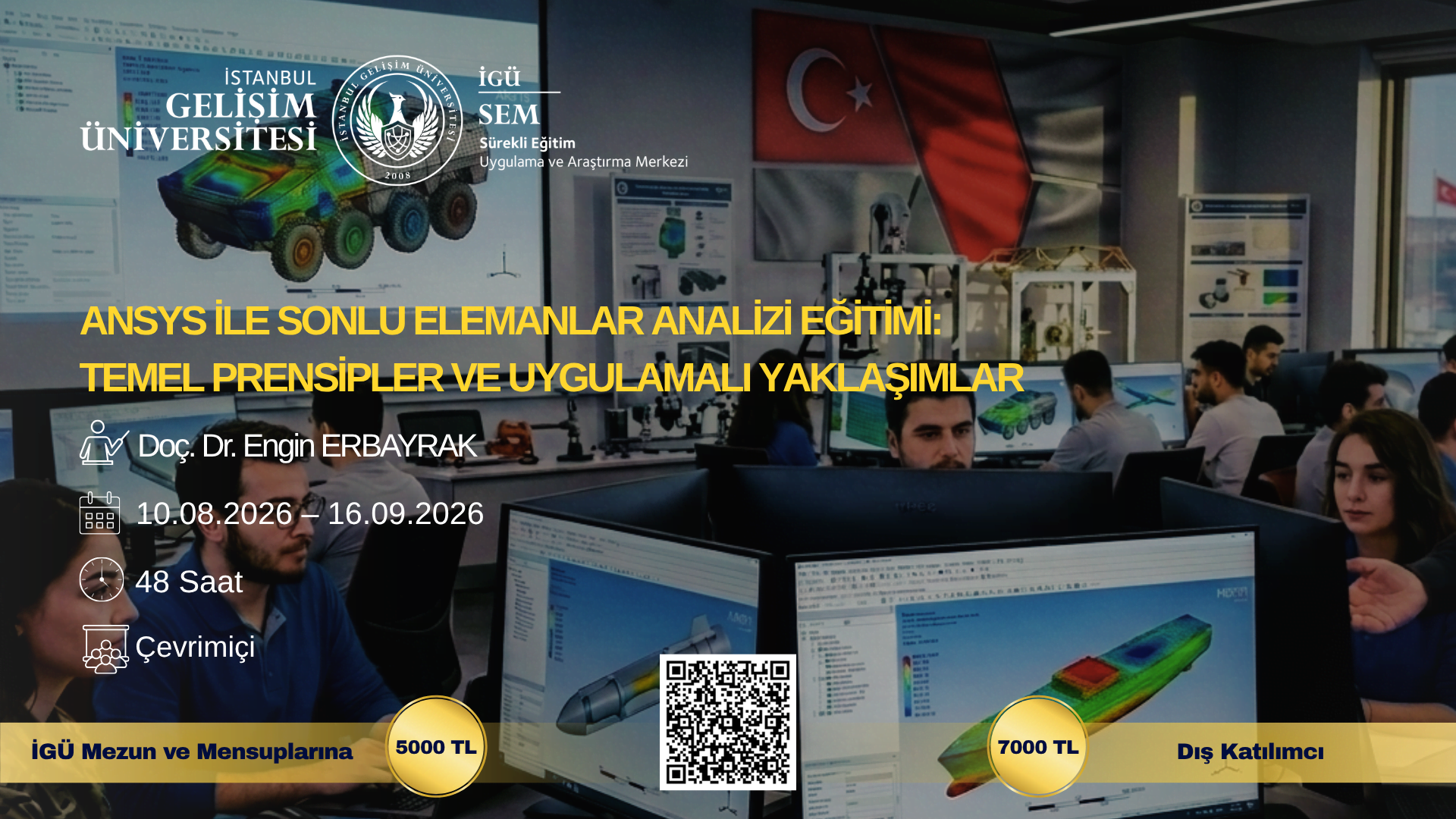
For detailed information and to register, you can scan the QR code shown in the image or visit the link below:
https://semsis.gelisim.edu.tr/on-basvuru-formu/74e0b154-f571-42e6-982f-2b8c94724b22
We invite you to join our program and wish you every success in your work.